


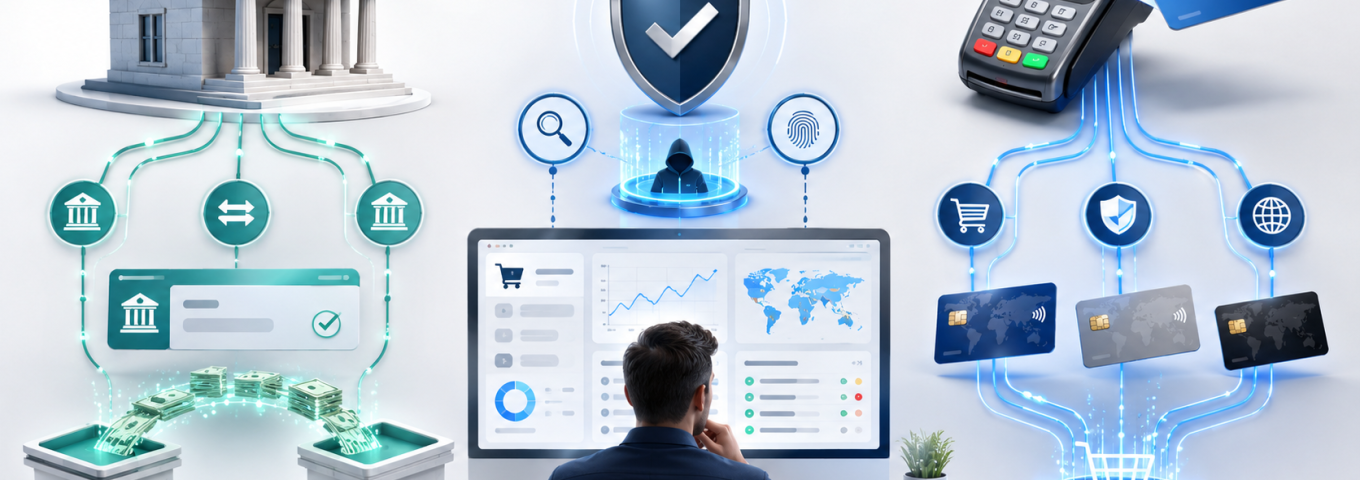
ACH vs Credit Card Processing for High-Risk Merchants

Introduction
High-risk merchants often need more than one way to accept payments. Credit card processing is familiar, fast, and convenient for customers, but it can also come with higher fees, chargebacks, reserves, declined transactions, and stricter underwriting for certain industries. ACH payment processing, on the other hand, allows businesses to accept bank-to-bank payments, which can be useful for recurring billing, high-ticket invoices, subscriptions, B2B payments, and backup payment strategies.
Understanding ACH vs credit card processing helps high-risk merchants choose the right payment mix. For many businesses, the answer is not one or the other. The best approach may be using both cards and ACH together to improve payment flexibility, reduce card dependency, and protect revenue.
Quick Answer: ACH vs Credit Card Processing
ACH payment processing moves funds directly between bank accounts, while credit card processing charges a customer’s card through card networks. ACH can be useful for recurring payments, invoices, B2B transactions, high-ticket sales, and backup payment options. Credit cards are usually better for fast ecommerce checkout, retail sales, and customer convenience. High-risk merchants often benefit from offering both payment methods.
What Is ACH Payment Processing?
ACH stands for Automated Clearing House. ACH payment processing allows businesses to collect or send electronic payments between bank accounts. For merchants, ACH is often used to debit a customer’s bank account after the customer gives authorization.
ACH is commonly used for:
Recurring subscriptions
Invoice payments
B2B payments
High-ticket transactions
Installment plans
Membership billing
Service retainers
eCheck payments
Backup payment options
Monthly billing
ACH is especially helpful when a business wants to reduce reliance on credit cards or needs a payment method better suited for larger or recurring payments.
What Is Credit Card Processing?
Credit card processing allows businesses to accept payments from customer credit or debit cards. The transaction is authorized through card networks and processed through a merchant account or payment processor.
Credit card processing is commonly used for:
Ecommerce checkout
Retail payments
Mobile payments
Online subscriptions
Digital product sales
In-person transactions
Restaurant and service payments
Fast customer purchases
Card-not-present transactions
Recurring billing
Credit cards are popular because customers are familiar with them and payments can be authorized quickly. However, high-risk merchants may face higher fees, chargeback concerns, or stricter processor rules.
ACH vs Credit Card Processing: Main Difference
The main difference is where the money comes from and how the payment is handled. ACH pulls funds from a bank account. Credit card processing charges a card through card networks.
| Feature | ACH Processing | Credit Card Processing |
|---|---|---|
| Payment source | Customer bank account | Customer credit or debit card |
| Best for | Recurring, invoice, B2B, high-ticket payments | Ecommerce, retail, fast checkout |
| Processing speed | Usually slower | Usually faster authorization |
| Customer familiarity | Moderate | Very high |
| Cost structure | Often flat or lower per transaction | Usually percentage-based |
| Dispute type | ACH returns and unauthorized debit claims | Card chargebacks |
| High-risk use | Good secondary or primary option for certain models | Often primary payment method |
| Settlement timing | May take longer | Depends on processor and risk |
| Ideal customer type | Businesses, repeat customers, larger payments | General consumers and online shoppers |
Both payment methods can be valuable, but they serve different needs.
Why High-Risk Merchants Compare ACH and Cards
High-risk merchants often compare ACH and credit cards because their payment setup directly affects approval, costs, disputes, reserves, and cash flow.
High-risk businesses may include:
CBD businesses
Adult websites
Travel agencies
Nutraceutical brands
Credit repair companies
Subscription businesses
Coaching programs
High-ticket ecommerce stores
Online course providers
Bad credit merchants
High-volume merchants
B2B service providers
These businesses may need payment flexibility because standard processors may restrict their industry or review transactions more carefully.
Benefits of ACH Processing for High-Risk Merchants
ACH can be useful for high-risk merchants that need payment options beyond cards.
Key benefits include:
Useful for high-ticket payments
Helpful for recurring billing
Supports invoice-based payments
Can reduce card dependency
May lower payment costs for some transactions
Useful for B2B payments
Can support payment plans
Helpful as backup when cards fail
Reduces reliance on card limits
Works well for repeat customers
ACH can be especially helpful when customers already have a relationship with the business and trust the payment process.
Limitations of ACH Processing
ACH is useful, but it is not perfect for every merchant.
Possible limitations include:
Slower processing than cards
Bank account authorization required
Customers may prefer cards
Not ideal for impulse purchases
Returns can still happen
Unauthorized debit claims are possible
International use may be limited
Bank account verification may be needed
High return rates can create account issues
Not every high-risk industry qualifies
ACH works best when customers understand the payment method and the business has clear authorization records.
Benefits of Credit Card Processing for High-Risk Merchants
Credit cards remain important for most businesses because they are convenient and familiar.
Key benefits include:
Fast customer checkout
High customer familiarity
Works well for ecommerce
Useful for mobile and retail payments
Supports impulse purchases
Easy for customers to use
Can support subscriptions
Widely accepted
Strong checkout conversion potential
Works with POS systems and online gateways
For many online businesses, credit cards are still the primary payment method customers expect.
Limitations of Credit Card Processing
High-risk merchants may face challenges with credit card processing.
Possible limitations include:
Higher fees for high-risk businesses
Chargeback risk
Processor restrictions
Account holds
Rolling reserves
Declined applications
Card declines
Expired or replaced cards
Subscription billing disputes
Card network rules
Stricter fraud monitoring
Possible account termination if unsupported
For high-risk merchants, cards are powerful but can also create more account pressure if disputes increase.
ACH Returns vs Credit Card Chargebacks
ACH and credit cards both have dispute risks, but the dispute process is different.
| Issue | ACH Processing | Credit Card Processing |
|---|---|---|
| Common dispute type | ACH return or unauthorized debit claim | Chargeback |
| Common reasons | Insufficient funds, invalid account, unauthorized debit | Fraud, product dispute, non-recognition, refund issue |
| Prevention | Clear authorization and bank verification | Clear terms, fraud tools, descriptors, support |
| Monitoring | Return ratio | Chargeback ratio |
| Customer action | Bank return or dispute | Cardholder chargeback |
| Merchant risk | Returns and unauthorized claims | Chargeback fees and dispute ratio |
High-risk merchants should track both ACH returns and card chargebacks carefully.
ACH vs Credit Card Processing Costs
Costs vary by provider, industry, volume, risk profile, transaction size, and underwriting terms.
ACH costs may include:
ACH transaction fees
Monthly account fees
Return fees
Unauthorized return fees
Gateway fees
Bank verification fees
Same-day ACH fees, if available
Setup fees, depending on provider
Risk monitoring fees
Credit card costs may include:
Transaction processing rates
Per-transaction fees
Monthly account fees
Gateway fees
Chargeback fees
PCI compliance fees
Statement fees
Rolling reserve requirements
Batch fees
Cross-border fees
ACH may be more cost-effective for larger payments in some cases, while credit cards may be better for fast customer checkout and ecommerce conversion.
Cost Comparison Table
| Cost Area | ACH Processing | Credit Card Processing |
|---|---|---|
| Per-payment cost | Often lower or flat-fee based | Often percentage-based |
| Chargeback/return cost | Return fees may apply | Chargeback fees may apply |
| Gateway cost | May apply | May apply |
| Monthly fee | May apply | May apply |
| Reserve risk | Possible for high-risk merchants | Common for high-risk merchants |
| Best cost fit | High-ticket and recurring payments | Smaller, fast, consumer payments |
Merchants should compare total cost, not just the transaction rate.
Which Is Better for High-Ticket Payments?
ACH is often useful for high-ticket payments because card fees can become expensive when transaction amounts are large. ACH may also reduce some card limit issues.
ACH may be better for:
Large invoices
Coaching programs
Travel packages
B2B services
Consulting retainers
High-ticket courses
Payment plans
Membership contracts
Credit cards may still be preferred when customers want rewards, speed, or convenience.
Which Is Better for Subscriptions?
Both ACH and credit cards can support subscriptions, but the better choice depends on the customer relationship and billing model.
Credit cards may be better for:
Consumer subscriptions
Fast online signup
Low-ticket recurring payments
Membership platforms
Digital product access
ACH may be better for:
Higher-ticket recurring payments
B2B subscriptions
Monthly retainers
Payment plans
Long-term service contracts
Customers comfortable with bank payments
Many subscription merchants offer both cards and ACH to reduce failed payments and improve flexibility.
Which Is Better for Ecommerce?
Credit cards are usually better for standard ecommerce checkout because customers expect card payment options and authorization is fast.
Credit cards may be better for:
Retail ecommerce
Quick checkout
Mobile shopping
Impulse purchases
Consumer products
Low to moderate ticket sizes
ACH may work for ecommerce when:
The order value is high
The customer is repeat or verified
The business sells B2B
The payment is invoice-based
The merchant wants a backup option
The transaction is part of a payment plan
For most ecommerce businesses, ACH is a supplement rather than a full card replacement.
Which Is Better for B2B Payments?
ACH is often a strong fit for B2B payments because businesses are used to bank transfers and invoices.
ACH may help with:
Large invoices
Recurring retainers
Vendor payments
Service contracts
Monthly billing
Professional services
Enterprise accounts
Lower card dependency
Credit cards may still be useful for smaller B2B purchases or when customers prefer card rewards.
Best Payment Setup by Business Type
| Business Type | Best Payment Mix |
|---|---|
| CBD ecommerce store | Cards + backup ACH/eCheck where supported |
| Adult subscription site | Cards + recurring billing controls; ACH where suitable |
| Travel agency | Cards + ACH/eCheck for large bookings |
| Nutraceutical brand | Cards + chargeback controls; ACH for large or recurring orders |
| Coaching program | ACH for payment plans + cards for deposits |
| B2B service provider | ACH primary + cards secondary |
| High-ticket ecommerce | Cards + ACH option for larger orders |
| Bad credit merchant | High-risk cards + ACH/eCheck review |
| High-volume merchant | Cards + ACH + risk monitoring |
The right mix depends on customers, transaction size, industry risk, and payment behavior.
When to Use ACH as a Backup Payment Method
ACH can be useful as a backup when card payments fail or become limited.
Use ACH as backup when:
Cards are declined
Customer card expires
Large card payment fails
Recurring card billing fails
Processor restricts card volume
Customer prefers bank payment
Invoice payment is needed
Payment plan is offered
High-ticket transaction needs lower card dependency
A backup payment method can reduce lost revenue.
Risk Controls for ACH and Cards
Both methods need risk controls.
For ACH, use:
Clear authorization
Bank account verification
Confirmation emails
Return monitoring
Recurring billing disclosure
Cancellation process
Customer support records
For cards, use:
Fraud filters
AVS and CVV
3D Secure where appropriate
Clear billing descriptors
Refund policy
Chargeback alerts
Customer support records
Risk control is essential for high-risk merchants using either method.
Common Mistakes High-Risk Merchants Make
Avoid these mistakes:
Using only one payment method
Assuming ACH has no disputes
Ignoring credit card chargebacks
Not collecting ACH authorization
Using unclear billing descriptors
Making refunds difficult
Not monitoring return rates
Not tracking chargeback reason codes
Choosing only based on low fees
Not confirming high-risk support
Not preparing underwriting documents
Not having backup payment options
A flexible payment strategy is stronger than relying on one payment rail.
Documents Needed for Approval
High-risk merchants may need documents for both ACH and card processing.
Common documents include:
Business registration
Owner ID
EIN or tax information
Business bank account details
Recent bank statements
Processing statements, if available
Website URL
Product or service description
Refund policy
Privacy policy
Terms and conditions
ACH authorization process, if applicable
Expected monthly volume
Average transaction amount
Chargeback or return history
Customer billing model
A complete application helps reduce delays.
How PayingSource Can Help
PayingSource helps high-risk merchants compare ACH, eCheck, credit card processing, merchant accounts, payment gateways, virtual terminals, and high-volume payment setups. For businesses that need flexibility, PayingSource can help review the best payment mix based on risk profile, transaction size, and customer payment behavior.
PayingSource can support merchants with:
ACH payment processing guidance
eCheck payment options
Credit card processing support
High-risk merchant account options
Online payment processing
Payment gateway support
Virtual terminal options
Recurring billing guidance
High-volume processing support
Chargeback and return risk guidance
Application preparation
Merchant services support
For high-risk businesses, the best payment setup often combines multiple methods instead of relying on only one.
FAQs
What is the difference between ACH and credit card processing?
ACH processing moves money directly between bank accounts, while credit card processing charges a customer’s card through card networks. ACH is often useful for invoices, recurring billing, and high-ticket payments, while cards are better for fast checkout.
Is ACH better than credit card processing?
ACH is better for some use cases, such as B2B invoices, high-ticket payments, and recurring bank payments. Credit cards are better for fast ecommerce checkout, retail sales, and customer convenience.
Can high-risk merchants use ACH?
Yes, some high-risk merchants may be able to use ACH depending on business type, return risk, bank statements, billing model, and underwriting approval.
Is ACH cheaper than credit card processing?
ACH may be cheaper for some transactions, especially larger payments, but total cost depends on the provider, business risk, volume, return fees, and monthly fees.
Does ACH have chargebacks?
ACH does not have card chargebacks in the same way, but ACH payments can be returned or disputed. Merchants must monitor return rates and unauthorized debit claims.
Should high-risk merchants offer both ACH and cards?
Yes, many high-risk merchants benefit from offering both. Cards support convenience and ecommerce checkout, while ACH can support recurring, invoice, B2B, and high-ticket payments.
How can PayingSource help compare ACH and cards?
PayingSource can help merchants review ACH, eCheck, and credit card processing options, understand approval requirements, compare risks, and build a payment setup that fits the business model.
Conclusion
ACH vs credit card processing is not a simple either-or decision for high-risk merchants. Credit cards are fast, familiar, and essential for many online and retail businesses. ACH can be useful for recurring billing, B2B invoices, high-ticket transactions, payment plans, and backup payment strategies.
For many high-risk businesses, the strongest payment setup includes both cards and ACH. This gives merchants more flexibility, reduces reliance on one payment method, and supports better long-term payment stability.
Need help comparing ACH and credit card processing? Apply with PayingSource today to explore payment processing options for your high-risk business.
Leave a Comments