


Payment Gateway vs Merchant Account: What Merchants Actually Need

Introduction
Many business owners use the terms payment gateway and merchant account as if they mean the same thing. In reality, they are two different parts of the payment process. A payment gateway helps capture and transmit payment details securely, while a merchant account allows the business to receive card payment funds after transactions are processed.
For small businesses, ecommerce stores, high-risk merchants, subscription brands, CBD businesses, adult sites, travel agencies, and service providers, understanding the difference matters. Choosing the wrong setup can lead to payment delays, declined applications, higher fees, or account holds. The right payment structure helps your business accept payments securely and manage transaction risk more effectively.
Quick Answer: Payment Gateway vs Merchant Account
A payment gateway is the technology that securely captures and sends payment information from a customer to the processor. A merchant account is the financial account that allows a business to accept card payments and receive funds after transactions are approved. Most online businesses need both. PayingSource helps merchants choose the right payment gateway, merchant account, virtual terminal, and payment processing setup based on their business type, risk level, and sales model.
What Is a Payment Gateway?
A payment gateway is the technology that connects your website, checkout page, virtual terminal, or payment form to the payment processor. It securely captures the customer’s card or payment details, encrypts the information, and sends it for authorization.
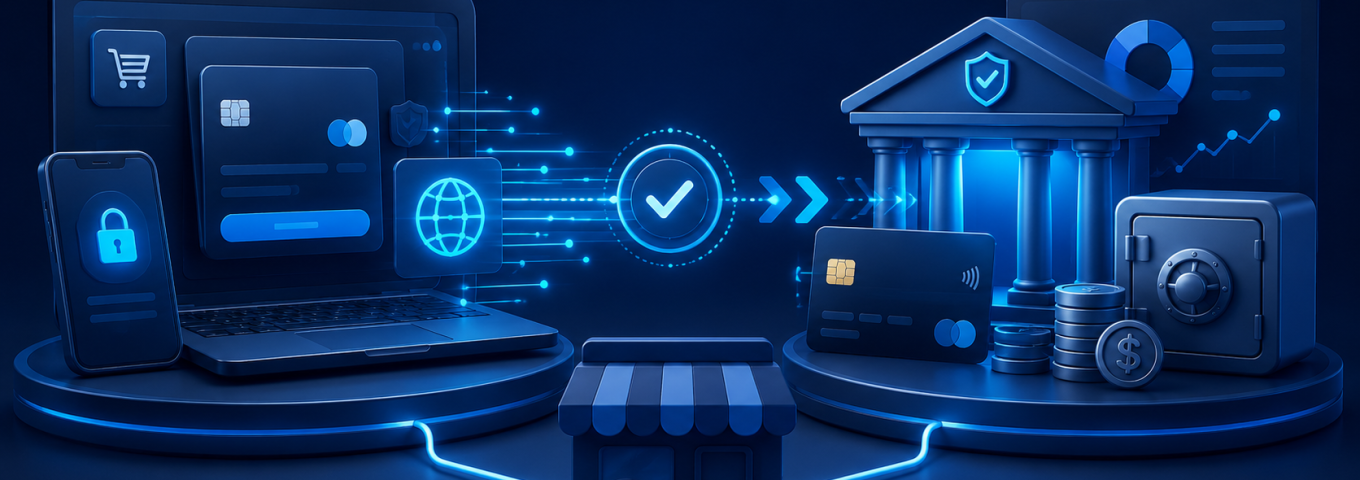
In simple terms, the payment gateway is the digital bridge between the customer and the payment network.
A payment gateway is commonly used for:
Ecommerce checkout pages
Online payment forms
Subscription billing
Invoice payments
Virtual terminals
Mobile payments
Hosted payment pages
API checkout integrations
For example, when a customer enters card details on your website, the payment gateway sends that information securely for approval. It does not usually hold your funds permanently. It helps move the transaction data safely through the payment system.
What Is a Merchant Account?
A merchant account is a type of business account that allows you to accept credit card and debit card payments. After a customer pays, the funds are processed through the payment network and then settled into your business bank account.
In simple terms, the merchant account is the financial part of the payment setup.
A merchant account helps businesses:
Accept card payments
Process customer transactions
Receive settled funds
Manage payment risk
Handle chargebacks
Support online, retail, or mobile payments
Work with payment gateways and processors
For high-risk businesses, the merchant account is especially important because standard processors may not support certain industries. A properly matched merchant account can give the business a more stable way to accept payments.
Payment Gateway vs Merchant Account: Main Difference
The easiest way to understand the difference is this:
The payment gateway moves payment information.
The merchant account allows the business to accept and receive card payment funds.
| Feature | Payment Gateway | Merchant Account |
|---|---|---|
| Main role | Sends payment data securely | Allows card payment acceptance |
| Used for | Checkout, online forms, virtual terminals | Processing and settlement |
| Handles funds? | Usually no | Yes, through settlement process |
| Needed for ecommerce? | Yes | Usually yes |
| Helps authorize payments? | Yes | Works with processor for approval |
| Handles chargebacks? | Limited role | More directly involved |
| Important for high-risk? | Yes | Very important |
| Example function | Customer enters card online | Business receives approved funds |
Both are important, but they solve different problems.
How They Work Together
A payment gateway and merchant account usually work together in the background whenever a customer makes a payment.
Here is a simplified process:
Customer enters payment details
Payment gateway encrypts and sends the data
Processor checks the transaction
Card network routes the request
Issuing bank approves or declines the payment
Merchant account receives approved transaction funds
Funds are later deposited into the business bank account
The customer may only see a checkout page, but several systems work together to complete the payment.
For online businesses, the gateway is usually visible through the checkout experience. The merchant account is less visible but just as important because it determines whether the business can accept and settle card payments.
Do You Need Both?
Most businesses that accept online card payments need both a payment gateway and a merchant account. However, some all-in-one payment platforms combine these functions into one simple setup.
That can work well for low-risk businesses. But for high-risk merchants, all-in-one platforms may create problems because the business can be approved quickly at first and reviewed later. If the platform later decides the business is outside its risk policy, the account may be frozen or terminated.
Businesses may need a dedicated merchant account when they:
Operate in a high-risk industry
Need more stable processing
Process high monthly volume
Use recurring billing
Sell regulated products
Have high average ticket sizes
Need custom gateway options
Need virtual terminal support
Have been declined by Stripe, Square, or PayPal
Need better underwriting alignment
For these businesses, a dedicated merchant account with the right gateway can be a better long-term solution.
Payment Gateway vs Processor vs Merchant Account
Many merchants also confuse payment gateways, processors, and merchant accounts. These are connected, but they are not exactly the same.
| Term | What It Does |
|---|---|
| Payment Gateway | Captures and transmits payment data securely |
| Payment Processor | Moves transaction information between banks and card networks |
| Merchant Account | Allows the business to accept card payments and receive funds |
| Business Bank Account | Receives deposits after settlement |
| Virtual Terminal | Lets merchants manually enter payments online |
| Hosted Payment Page | Secure checkout page hosted for payment acceptance |
Think of it like this: the gateway sends the payment information, the processor routes the transaction, the merchant account supports acceptance and settlement, and the business bank account receives the final deposits.
Why This Matters for High-Risk Merchants
For high-risk merchants, the difference between a gateway and merchant account is not just technical. It affects approval, stability, fees, chargebacks, reserves, and long-term payment access.
A high-risk business may have a working gateway but still need the right merchant account behind it. Without the right account, the business may face declined applications, account holds, delayed deposits, or sudden shutdowns.
High-risk businesses may include:
CBD stores
Adult content businesses
Travel agencies
Nutraceutical brands
Subscription businesses
Credit repair companies
Coaching programs
High-ticket ecommerce
International ecommerce
Online courses
High-volume merchants
These businesses often need payment partners that understand their risk profile from the beginning.
Costs and Fees to Expect
Payment costs depend on the business model, risk level, processing volume, average transaction size, chargeback history, and gateway setup.
Possible payment gateway costs include:
Monthly gateway fee
Transaction fee
API or integration fee
Hosted payment page fee
Virtual terminal fee
Fraud prevention tool fees
Possible merchant account costs include:
Processing rates
Monthly account fees
Statement fees
Chargeback fees
PCI compliance fees
Batch fees
Rolling reserve requirements
Early termination fees, depending on provider
High-risk businesses may pay higher fees than standard merchants because the processor and acquiring bank take on more risk. However, paying slightly higher fees for a properly approved account is often better than using an unsupported platform that may freeze funds later.
Which Setup Is Best for Your Business?
The best setup depends on how your business accepts payments and what level of risk your industry carries.
| Business Type | Recommended Setup |
|---|---|
| Simple retail business | Merchant account + POS system |
| Ecommerce store | Payment gateway + merchant account |
| Service business | Virtual terminal + merchant account |
| Subscription business | Gateway with recurring billing + merchant account |
| High-risk ecommerce | High-risk gateway + high-risk merchant account |
| High-volume business | Scalable merchant account + gateway support |
| Mobile business | Mobile payment tools + merchant account |
| Phone order business | Virtual terminal + merchant account |
If your business only needs occasional in-person payments, a basic POS setup may work. If your business sells online, a payment gateway becomes essential. If your business is high-risk, the merchant account must be properly matched to your category.
Common Mistakes Merchants Make
Many payment problems happen because merchants choose a payment solution without understanding how the parts work together.
Common mistakes include:
Assuming a gateway alone is enough
Using a low-risk platform for a high-risk business
Ignoring chargeback policies
Not reading processor restrictions
Choosing only based on low fees
Using unclear website policies
Not checking recurring billing support
Not asking about reserves
Not planning for growth
Not confirming industry acceptance
For high-risk businesses, the biggest mistake is choosing a provider that does not actually support the industry. That can lead to account freezes, withheld funds, or sudden termination.
How PayingSource Can Help
PayingSource helps businesses choose payment processing solutions based on how they sell, what industry they operate in, and what level of risk they carry. For merchants that need both a payment gateway and merchant account, PayingSource can help identify the right setup for online, retail, mobile, high-risk, and high-volume payment needs.
PayingSource can support merchants with:
Merchant account setup
Payment gateway guidance
High-risk payment processing
Online payment processing
Virtual terminals
POS systems
High-volume processing
Application support
Payment acceptance strategy
Merchant service support
The goal is to help businesses accept payments securely while reducing approval issues, processing interruptions, and unnecessary friction.
FAQs
What is the difference between a payment gateway and a merchant account?
A payment gateway securely captures and sends payment data for authorization. A merchant account allows the business to accept card payments and receive funds after approved transactions are processed.
Do I need a merchant account if I already have a payment gateway?
Usually, yes. A payment gateway sends transaction data, but a merchant account is needed to accept and settle card payments. Some platforms combine both, but high-risk businesses often need a dedicated merchant account.
Can I accept online payments without a payment gateway?
For ecommerce and online payments, you usually need a payment gateway or hosted payment page. Retail businesses may use a POS system instead, but online businesses need a secure way to capture payment details.
Is Stripe a payment gateway or merchant account?
Stripe is often used as an all-in-one payment platform that combines gateway and processing functions. However, some high-risk industries may not be supported, which is why certain businesses need a dedicated high-risk merchant account.
Why do high-risk businesses need a special merchant account?
High-risk businesses need special merchant accounts because they may have higher chargeback risk, regulatory concerns, larger ticket sizes, recurring billing, or restricted product categories. Standard processors may decline or terminate these accounts.
What is better: a payment gateway or merchant account?
They are not direct replacements. A payment gateway handles secure transaction data, while a merchant account supports payment acceptance and settlement. Most online businesses need both.
How can PayingSource help me choose the right setup?
PayingSource can help review your business model, industry, payment needs, risk level, and processing goals to recommend a suitable merchant account, gateway, virtual terminal, or payment processing solution.
Conclusion
Understanding payment gateway vs merchant account is important for any business that wants to accept payments securely. A payment gateway moves payment data, while a merchant account allows the business to accept and receive card payments. For many online and high-risk businesses, both are needed.
The right setup can improve approval chances, reduce payment disruptions, support chargeback management, and create a more stable foundation for growth. PayingSource helps merchants choose payment processing solutions that fit their business type, risk profile, and sales model.
Need help choosing the right payment gateway and merchant account setup? Contact PayingSource or apply today to get started.